

By All In Central · Updated
Texas Hold'em is the most popular form of poker. Each player gets two private cards and shares five community cards. The goal: make the best five-card hand — or get everyone else to fold.
The objective
You win a pot in one of two ways: by having the best five-card hand at the showdown, or by betting in a way that makes every other player fold before then. Your five-card hand is built from any combination of your two hole cards and the five community cards. See the full hand rankings.
The table & the blinds
A round disc called the button marks the dealer and moves one seat clockwise each hand. The two players left of the button post forced bets: the small blind and the big blind. Blinds rise over time — that's what the poker timer keeps track of.
Table position
Position means where you sit relative to the button, and it decides the order players act in every betting round after preflop. Acting later gives you more information, since you get to see what everyone before you does before you decide.
- Early position — the seats closest to the left of the big blind, including under the gun. You act first with the least information, so hands here need to be stronger.
- Middle position — the seats between early and late position — a bit more information than early position, but players behind you can still raise or reraise.
- Late position — the cutoff and the button. You act last (or close to it) on every post-flop round, which is the single strongest seat at the table.
- Beginner tip — widen your starting-hand range as you move later. A hand you'd fold under the gun can become a reasonable open on the button because you'll have position for the rest of the hand.
The deal & betting rounds
Every player is dealt two face-down hole cards, then the action moves through four betting rounds:
- Preflop — betting starts after the hole cards are dealt, beginning left of the big blind.
- The flop — three community cards are dealt face up; another round of betting follows.
- The turn — a fourth community card, then betting.
- The river — the fifth and final community card, then the last round of betting.
Betting order: who acts first
Action always moves clockwise, one player at a time. What changes from round to round is who starts it:
- Preflop — the player directly left of the big blind (the under the gun seat) acts first. The big blind acts last, and if nobody has raised it can still check or raise (its “option”).
- Flop, turn and river — the first player still in the hand to the left of the button acts first — usually the small blind — and the button acts last.
- Heads-up — with only two players, the button posts the small blind and acts first before the flop, then last on the flop, turn and river.
- The first button — most home games deal one card face up to each player; the highest card takes the button for the first hand (redeal any tie), and it moves one seat clockwise after every hand.
Your options on each turn
- Check — pass the action with no bet (only if no one has bet).
- Bet / Raise — put chips in, or increase a bet already made.
- Call — match the current bet to stay in the hand.
- Fold — give up your hand and any chips already in the pot.
- All-in — bet every chip you have left.
Pot odds
Pot odds compare the cost of a call to the size of the pot you'd be winning, turning a gut-feel decision into a simple ratio. For example, if there's $80 in the pot and your opponent bets $20, you're being asked to put in $20 to win $100 (the $80 plus their $20 bet) — pot odds of 5:1, meaning you need to win the hand only about 1 time in 6, or roughly 17%, for calling to break even.
- The math — add the current pot to your opponent's bet to get what you'd win, then compare that to the cost of your call. An $80 pot plus a $20 bet makes $100 to win for a $20 call — pot odds of 5:1.
- Turning it into equity — divide the call by the total pot after you call: $20 ⁄ $120 ≈ 17%. That's the minimum chance you need of making the best hand for calling to pay off long-term.
- Using it on a draw — count your outs, estimate your rough chance to hit them by the river, and compare that percentage to what pot odds require. If your odds of improving beat the price you're being offered, calling is a good bet.
- When it doesn't apply — pot odds assume the hand goes to showdown. They matter less if you plan to fold to further aggression, or if hitting your draw won't win you the pot anyway.
All-in and side pots
Going all-in means betting every chip you have left. If you have fewer chips than the others still in the hand, a side pot forms so the betting can continue among the players with more behind.
- How the side pot forms — the main pot is capped at what the all-in player put in, matched by each opponent. Any further betting from the remaining players goes into a separate side pot the all-in player has no claim to.
- Who you can win from — an all-in player can only win chips from opponents they covered dollar-for-dollar. Anything an opponent bets beyond that just builds a side pot between the other players.
- All-in protection — no player can be forced to fold more chips than they have. Once you're all-in, you're guaranteed to see the rest of the board play out for the pot (or pots) you're eligible to win.
- Not the same as being bullied out — this protection only covers chips you don't have. It doesn't stop opponents from betting big while you still have chips behind, which can still push you to a tough decision or a fold.
The showdown
If two or more players remain after the river, cards are revealed and the best five-card hand wins the pot. Tied hands split the pot. When hands are otherwise equal, the highest side card — the kicker — decides it.
Hand rankings at a glance
Every showdown is settled by the same order of poker hands. From best to worst:
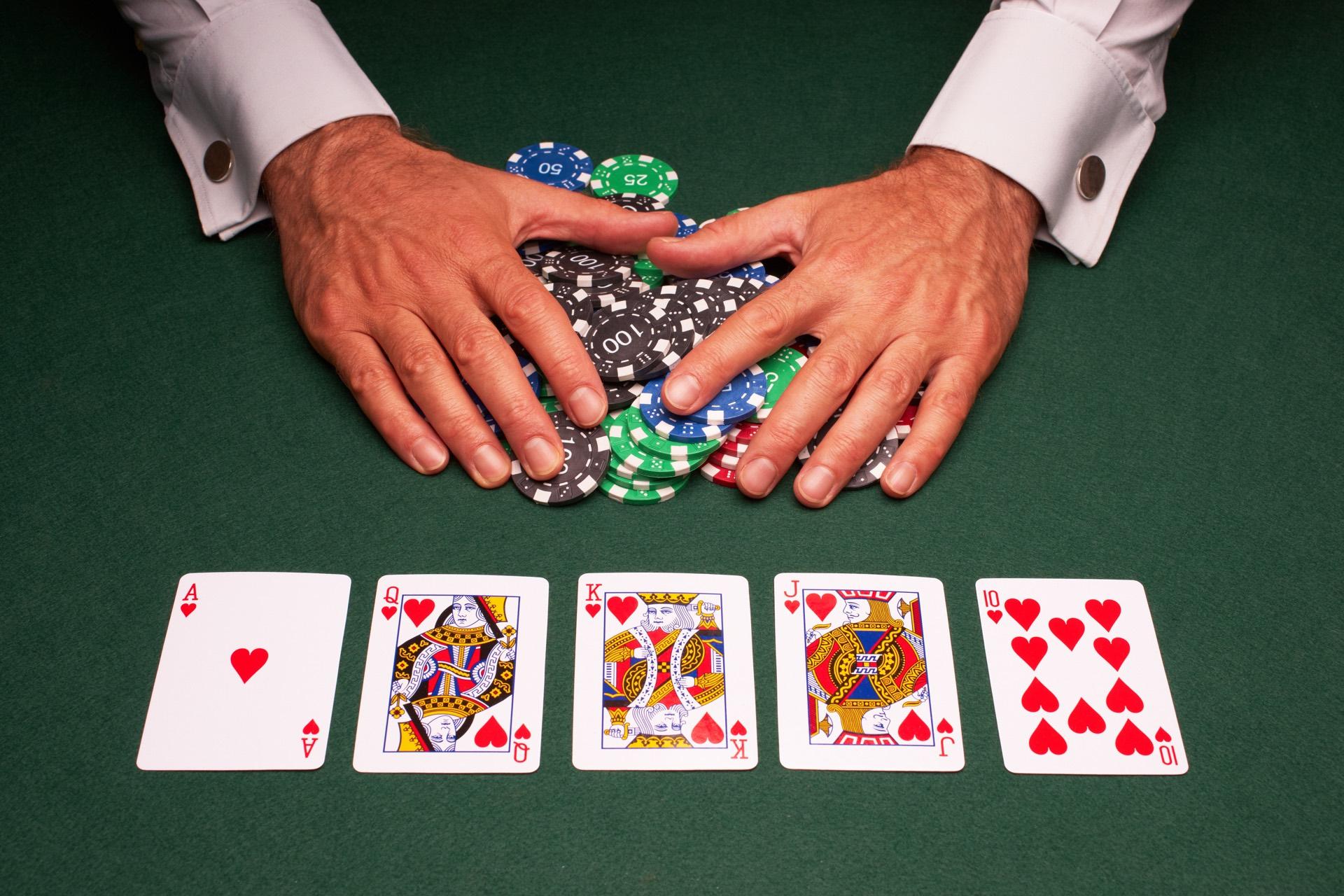
- Royal flush — A-K-Q-J-10, all one suit.
- Straight flush — five cards in a row, all one suit.
- Four of a kind — four cards of the same rank.
- Full house — three of a kind plus a pair.
- Flush — any five cards of one suit.
- Straight — five cards in a row, mixed suits.
- Three of a kind — three cards of the same rank.
- Two pair — two different pairs.
- One pair — two cards of the same rank.
- High card — none of the above — your highest card plays.
Examples, odds and every tie-break are on the poker hand rankings page — or keep the printable hand rankings chart by the table.
Muck
To muck a hand means to fold it face down without showing your cards, and it also refers to the dealer's pile of dead cards. Once a hand is folded, it's out of the pot for good — and even at showdown, a hand that gets mucked is normally treated as dead and can't be reinstated, even if it would have won, except in rare cases where the floor rules otherwise (for example dealer error or bad information given to the player).
- Folding into the muck — when you fold, you slide your cards face down toward the dealer, who mixes them into the muck pile. No one sees what you had.
- Automatic muck — if you're clearly beaten and have no obligation to show (for example you didn't bet or raise on the last round), the dealer may muck your hand for you if you don't act.
- When you must show — the last player to bet or raise on the river must show their hand first at showdown. Rules vary by room, but bettors generally can't muck without showing.
- The muck rule — once a hand touches the muck it's normally treated as dead and can't be reinstated, even if it would have won — dealers wait until a hand is clearly beaten before sweeping it away, and only a floor ruling (for example after dealer error) can occasionally reverse that.
Quick etiquette
- Act in turn — don't fold or bet out of order.
- Make your bet in one motion; reaching back for more chips (a “string bet”) isn't allowed.
- Keep your cards on the table and protect them.
- Keep phones and side conversations away from live hands.
Common questions
- How do you play Texas Hold'em?
- Each player is dealt two private hole cards face down, and the table shares five community cards dealt face up in the middle. Before any cards are dealt, the two players left of the dealer button post forced bets called the small blind and big blind, which get the pot started. From there, betting runs through four rounds: preflop, the flop, the turn and the river. On each round you can check, bet, call, raise or fold. If two or more players are still in at showdown, whoever makes the best five-card hand from their two hole cards and the five community cards wins the pot. Most hands never reach showdown, though — if a bet goes unmatched, the last player left standing takes the pot without needing to show a hand at all.
- Who goes first in Texas Hold'em?
- Before the flop, the player directly to the left of the big blind — the 'under the gun' seat — acts first, and the big blind acts last. On the flop, turn and river, the first player still in the hand to the left of the dealer button acts first, usually the small blind, and the button acts last. The one exception is heads-up play: with only two players, the button posts the small blind, acts first before the flop and last after it. For the very first hand, most home games deal one card face up to each player and give the button to the highest card.
- What are the four betting rounds in poker?
- Preflop happens right after each player gets their two hole cards, with betting starting on the player to the left of the big blind. Then comes the flop, when the dealer burns one card and deals three community cards face up together. The turn adds a fourth community card, and the river adds the fifth and final one. A full betting round follows each stage — on the flop, turn and river, action starts with the first active player left of the button (usually the small blind), the same reference point used preflop, just one seat earlier since the blinds have already posted their forced bets. A common misconception is that you must bet every round — checking (passing the action along with no bet) is allowed whenever nobody has bet yet in that round. Once the river betting finishes, any players left go to showdown.
- What is the flop, turn and river?
- The flop, turn and river are the three stages at which community cards appear on the board. The flop comes first: three cards dealt face up at once, right after a single card is burned (discarded unseen) to guard against anyone having glimpsed or tracked the top card of the deck. The turn adds a fourth card, and the river adds the fifth and final one, each preceded by its own burn card and followed by a betting round. All five community cards are shared, so every player at the table can use any combination of them alongside their own two hole cards. A common misconception is that you must use both hole cards — you don't. You can even play the board, using all five community cards and none of your own, if that gives you the best hand.
- When can you go all-in in poker?
- You can go all-in any time it's your turn to act, by betting every chip you have left in one move. It's most common when you're short-stacked and want to maximize fold equity or commit before a scary card lands, but nothing stops you from doing it with a big stack too. If one or more opponents cover you (have more chips), their extra chips beyond what you put in form a side pot that you're not eligible to win, even though you stay in the hand for the main pot. This matters most with three or more players: the short stack can only ever win what everyone contributed up to their all-in amount, while the bigger stacks keep betting for the side pot. You're never forced to fold once all-in; you simply see the remaining cards for free.